








Building Envelope Performance, Efficiency and Lifecycle Approach
The future of sustainable architecture is shaped not only by buildings designed to reduce energy consumption, but also by building systems whose environmental impacts can be measured throughout their entire lifecycle—from design and manufacturing to operation and end-of-life recovery.
Climate change, efficient resource utilization, and the need to reduce the carbon footprint of the construction industry have become fundamental design considerations in contemporary architecture.
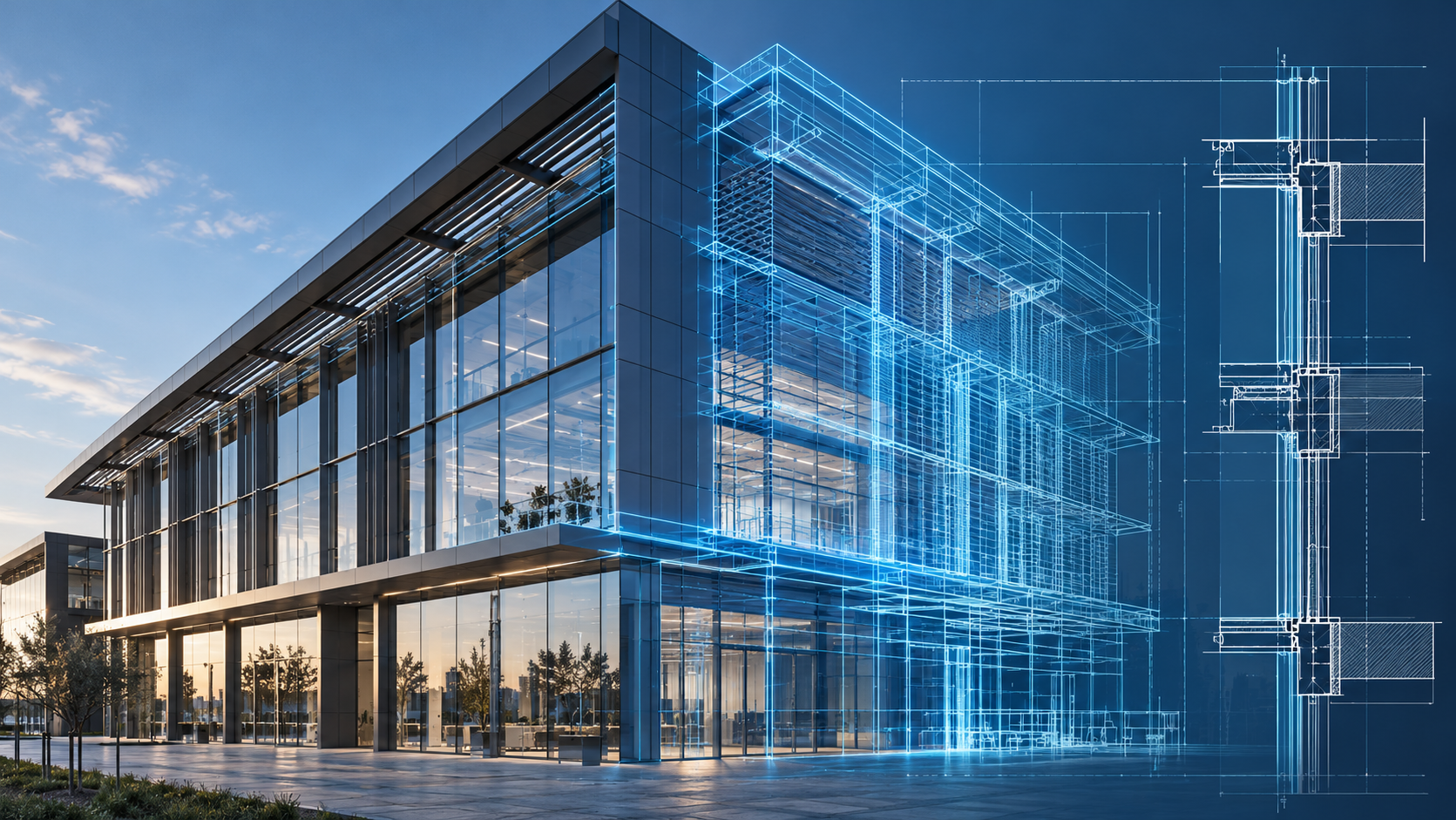
Within this transformation, the building envelope is evolving beyond its conventional role as an architectural element separating interior and exterior environments. Façade systems are increasingly becoming engineered solutions that directly influence energy performance, indoor environmental comfort, material consumption, and the long-term environmental impact of buildings.
The fundamental principle of sustainable façade design lies in evaluating architectural aesthetics and technical performance within a holistic, integrated system.
1. A New Benchmark for Sustainability: Lifecycle Performance
While traditional approaches to energy efficiency have primarily focused on energy consumption during building operation, contemporary sustainability assessments require a significantly broader perspective.
The environmental impact of a building encompasses material production, transportation, installation, maintenance and replacement throughout its service life, as well as dismantling and recycling processes at the end of its useful life.
This approach is known as Life Cycle Assessment (LCA).
In façade engineering, LCA supports the selection of systems that not only contribute to operational energy savings but also seek to optimize environmental impacts throughout manufacturing, installation, operation, and end-of-life processes.
2. Engineering Principles of Energy-Efficient Façade Systems
A building’s energy performance is directly influenced by the thermal characteristics of its façade systems and their interaction with solar radiation.
Three fundamental performance parameters are particularly significant:
- Thermal Transmittance (U-value): Used to assess the rate of heat transfer through a building component.
- Total Solar Energy Transmittance (g-value): Represents the proportion of incident solar energy transmitted into the interior through a glazing system.
- Visible Light Transmittance (LT): Defines the proportion of visible daylight transmitted through glazing into interior spaces.
Evaluating these parameters collectively plays an important role in balancing heating and cooling loads.
However, selecting high-performance glazing alone does not guarantee an energy-efficient façade system.
The thermal characteristics of aluminium profiles, glazing edge connections, anchorage details, airtightness, and solar shading elements also contribute to the overall performance of the system.
Sustainable façade design therefore requires engineering assessments that consider the performance of the complete integrated system rather than evaluating individual materials in isolation.
3. The Role of Aluminium and Glass in the Circular Economy
Aluminium and glass are two fundamental materials widely used in architectural façade systems, both offering significant recycling potential.
The ability to remelt and reuse aluminium provides substantial opportunities for energy savings compared with primary aluminium production. However, the actual environmental benefits depend on factors such as recycled content, manufacturing methods, and the energy sources employed.
For glazing systems, recycling opportunities are influenced by factors including coating technologies, laminated glass composition, and the ability to separate constituent materials.
In this context, sustainability extends beyond the selection of recyclable materials.
Material efficiency, reduction of manufacturing waste, long-lasting component design, and the ability to separate materials at the end of their service life are essential principles of the circular economy.
4. Digital Design and Resource Efficiency
Digital modeling and engineering analysis provide valuable tools for developing sustainable façade solutions.
BIM-based coordination, parametric design, and digital manufacturing planning can support more accurate material quantity calculations, geometric optimization, and controlled management of manufacturing processes.
In particular, optimizing aluminium profile cutting patterns, accurately planning glass dimensions, and evaluating connection details for manufacturability can contribute to more efficient resource utilization.
The contribution of digital transformation to sustainability is therefore not limited to accelerating manufacturing processes. Its greater value lies in optimizing material and energy consumption through data-driven engineering decisions.
5. Durability and Extended Service Life
An essential, yet sometimes underestimated, consideration in sustainable façade design is the service life of the system.
The environmental performance of a façade system is determined not only by the impacts associated with its initial production but also by its maintenance, repair, and replacement requirements throughout its operational life.
Corrosion resistance, connection integrity, gasket performance, glazing system compatibility, and the interaction between different materials must all be evaluated to ensure long-term durability.
Furthermore, designing components for replacement when necessary and incorporating maintenance accessibility into façade detailing can help reduce resource consumption throughout the system’s service life.
Durability is therefore not merely a technical requirement but also a fundamental environmental consideration in sustainable architecture.
6. International Standards and Environmental Performance Verification
The ability to measure and compare environmental performance is becoming increasingly important in sustainable building design.
ISO 14040 and ISO 14044 establish the fundamental methodological framework for Life Cycle Assessment, while EN 15804 defines the core rules governing Environmental Product Declarations for construction products.
Environmental Product Declarations (EPDs) provide verified information on the environmental impacts of construction products across defined lifecycle stages.
However, the existence of an EPD does not, in itself, establish that a product has superior environmental performance. Meaningful comparisons require functional equivalence, consistent data boundaries, and compatible assessment methodologies.
Green building assessment systems such as LEED and BREEAM support the evaluation of sustainability criteria at the project level, covering aspects ranging from material selection to energy performance.
The European Union’s revised Energy Performance of Buildings Directive (EPBD), adopted in 2024, reflects the increasing importance of lifecycle carbon performance within sustainable building regulations.
Under the Directive, the lifecycle Global Warming Potential (GWP) of new buildings with a useful floor area exceeding 1,000 m² must be calculated and disclosed in their Energy Performance Certificates from 2028. From 2030, this requirement will extend to all new buildings within the European Union.
These developments indicate that environmental product data and comprehensive carbon assessments will play an increasingly influential role in future architectural and engineering decisions.
7. The Future of the Building Envelope: Integrated Performance
The evolution of sustainable architectural solutions requires façade systems to be considered not merely as physical building components, but as integrated systems that influence a building’s overall energy and environmental performance.
Climate-responsive design, high-performance glazing systems, optimized aluminium components, effective solar control, and digital engineering methodologies are among the key elements driving this transformation.
The primary objective of future façade engineering will not be to incorporate more technology, but to align the right technologies, materials, and engineering strategies with the specific requirements of each project.
Sustainable architecture is more than a design philosophy reflecting environmental responsibility. It is a multidisciplinary engineering process that must be supported by measurable performance criteria.
The integrated consideration of energy efficiency, material optimization, durability, circular economy principles, and lifecycle assessments plays a decisive role in improving the environmental performance of the building envelope.
The true value of sustainability lies in developing building solutions that not only meet the needs of today but also preserve resources for future generations.
Yenilikçi teknolojilerle donatılmış üretim süreci ve sürdürülebilir malzeme kullanımı sayesinde, projelerinizi çevreye duyarlı hale getirmek çok daha kolay. Alüminyumun dayanıklılığı ve geri dönüştürülebilir olması, hem ticari hem de bireysel projelerde fark yaratmanıza yardımcı olurken, doğayı koruma hedeflerinize de ulaşmanızı sağlıyor.